
Iliotobial Band (IT Band) Syndrome
The Iliotibial Band (IT Band) is a thick band of tissue that runs along the outside of your thigh, from your hip down to your knee. It helps stabilize both joints when you move. IT Band Syndrome occurs when that tissue becomes irritated from repeated movements like running or cycling, and it typically shows up as tightness or pain on the outer side of the knee or hip. Though less than 25% of the population experience these symptoms, they do occur in females more frequently than males. ¹
On this page, you will learn what causes IT Band Syndrome, how it is diagnosed, and what treatment looks like. We also cover recovery timelines and what to expect during each phase of rehab. The goal is to help you understand what is happening, know what comes next, and feel confident moving forward toward full recovery.
OVERVIEW
The Iliotibial Band (IT Band) is a long, thick band of tissue that runs along the outside of the thigh. It starts at a bony point on the front of the hip and travels down to attach to the outer side of the shin bone, just below the knee. It also connects to tissue around the kneecap, thigh bone, and hamstring insertion. The IT Band plays a key role in stabilizing the hip and knee during movement.
ANATOMY
IT Band Syndrome occurs when the IT Band rubs against a bony area near the hip or knee, causing friction and irritation. Normally, the IT Band is flexible and glides smoothly, allowing you to move without pain. When it becomes too tight, that friction increases and irritation builds up. There are several reasons why the IT band can become tight and weak, and it is usually from repeated motion and overuse.
MECHANISM OF INJURY
TYPES OF INJURY
IT Band Syndrome can occur on one side (unilateral) or both sides (bilateral), depending on your anatomy and how you move. Symptoms can appear at the hip (proximal) or at the knee (distal). Higher training volume like doing more total work in your overall training increases the risk. Where you feel pain depends on which part of the body is under the most stress.
If the IT Band is rubbing over the hip bone, you may feel pain there and sometimes hear a snapping sound, also called snapping hip syndrome. If pain is closer to the knee, you may feel or hear a click, snap, or pop as the IT Band rubs over the bone when the knee bends and straightens.
In more acute (short-term) cases, you may feel burning or aching at the start of exercise and for a period afterward. In more chronic (long-term) cases, pain can be present even at rest and may limit your ability to exercise.
Your anatomy can also play a role. You may have a higher risk of IT Band Syndrome if you have a leg length discrepancy (one leg longer than the other), flat feet, bowed legs, a toed-in stance, knee or hip osteoarthritis, or weakness in your core and leg muscles.
IT Band Syndrome is usually diagnosed based on a cluster of symptoms. Your Physical Therapist (PT) will start by asking about your history. First when the pain started, then where you feel it, and the kind of activity makes it worse. Key signs include pain on the outer side of the hip or knee, warmth near the painful area, and an audible sound when the joint moves.
Your PT may also perform a palpation (hands-on pressure) along the bony areas of the hip and knee to check for tenderness, tissue tension, and temperature changes. Special tests like Ober's Test or the Modified Thomas Test may be used to assess tightness and mobility. Manual muscle tests can help identify weakness in the core and legs. Movement and gait analysis (watching how you walk and move) may also be performed to spot imbalances or find positions that trigger your symptoms.
If symptoms persist and conservative care does not help, imaging may be recommended. A Dynamic Ultrasound can look at your tissues while you are moving, and an MRI can help rule out other possible causes. Your provider will use those results to guide next steps and build a plan that fits your specific needs.
DIAGNOSIS
TREATMENT TIMELINE
Early Treatment
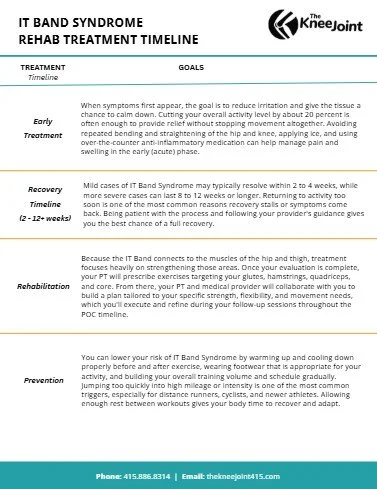
When symptoms first appear, the goal is to reduce irritation and give the tissue a chance to calm down. Cutting your overall activity level by about 20 percent is often enough to provide relief without stopping movement altogether. Avoiding repeated bending and straightening of the hip and knee, applying ice, and using over-the-counter anti-inflammatory medication can help manage pain and swelling in the early (acute) phase.
Recovery Timeline (2 - 12+ weeks)
Mild cases of IT Band Syndrome may typically resolve within 2 to 4 weeks, while more severe cases can last 8 to 12 weeks or longer. Returning to activity too soon is one of the most common reasons recovery stalls or symptoms come back. Being patient with the process and following your provider's guidance gives you the best chance of a full recovery.
Rehabilitation
Because the IT Band connects to the muscles of the hip and thigh, treatment focuses heavily on strengthening those areas. Once your evaluation is complete, your PT will prescribe exercises targeting your glutes, hamstrings, quadriceps, and core. From there, your PT and medical provider will collaborate with you to build a plan tailored to your specific strength, flexibility, and movement needs, which you'll execute and refine during your follow-up sessions throughout the POC timeline.
Prevention
You can lower your risk of IT Band Syndrome by warming up and cooling down properly before and after exercise, wearing footwear that is appropriate for your activity, and building your overall training volume and schedule gradually. Jumping too quickly into high mileage or intensity is one of the most common triggers, especially for distance runners, cyclists, and newer athletes. Allowing enough rest between workouts gives your body time to recover and adapt.
ADDITIONAL RESOURCES
The Knee Joint ACL REHAB PHASES & TIMELINE
This printable PDF one sheet includes information about what to expect in the weeks and months following ACL surgery and rehab in addition to goals to keep in mind as you progress from Week 1 to Month 18. Download and reference it whenever you’d like support, want to build momentum and feel focused in your recovery journey.
One Sheet
Blog Post
Articles
How to fix a tight IT Band - from @conor_harris_
¹ Cleveland Clinic. Iliotibial Band Syndrome (ITBS): Causes, Symptoms & Treatment. Cleveland Clinic Health Library. https://my.clevelandclinic.org/health/diseases/21967-iliotibial-band-syndrome. Last updated October 19, 2021. Accessed June 27, 2026.